Towermates
Towermates (towermen, rooks, rathers)
Les Songes Drolatiques de Pantagruel:
Woodcuts as game material.
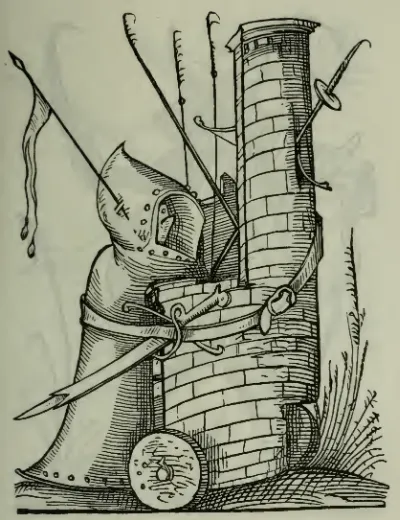
Towermates travel the roads with (and generally inside) their portable fortresses, small defensive structures on sledges or wheels, movable and defensible by a single fighter. Very few of even the most hardened brigands and bandits will attack a towermate without a solid plan and superior numbers: these stony individuals are strong and mean (and for the most part impecunious).
Travelers are forewarned of towermate approach by the rumbling of stone as well as the siffling of wind through drones and noisemakers. (The noisemakers pictured here are charm-locust legs on ash poles that sway as the tower moves.) Towermates do not move quietly or quickly, but they rarely stop moving. This constant grueling travel, heavy armor, and frequent combat all take tolls on the towermates' bodies, which are often bent and bowed.
The traveling towers tend to attract gremlins. In any other building, these little creatures are regarded as vermin to be extirpated. But gremlins and towermates seem to have found a symbiosis: the gremlins inhabit and repair the towers, provision the towermates through their small constant hunting and gathering, and aid as they can in battle, all while benefiting from shelter, protection, and travel. (More on gremlins in a later entry.)
Civilized areas do not appreciate towermates. They don't buy lodging or supplies, they don't provide novel conversation or news, and they shed gremlins.
Fortunately for civilized areas, towermates are by nature solitary, gremlins to the contrary notwithstanding. In fact, they approach one another warily if at all. A typical chance meeting on a road is full of slow advances and defensive posturing. Three major exceptions occur, though.
One exception is when towermates are hired as mercenaries. In those cases, towermates will work together to arrange their structures into a quick but tight defensive wall and themselves into a capable military unit defending that wall. As soon as the battle is over, the towermates scatter, no matter how cordial their relationships on the battlefield.
Another exception is a meson-mote. From time to time during the course of a towermate’s life, he will find himself in need of a larger or smaller tower. Perhaps the years of travel have begun to weigh on him physically, or perhaps he wishes to have space for more gremlins. Small groups of towermates will meet via some signal not detectable by anyone else and will exchange tower pieces or sometimes entire structures. Any gremlins present will mingle. Many will join new structures, as long as there's room.
When a towermate becomes elderly (though who's to say what elderly means?), one of three things might happen. Sometimes he will simply stop wherever he is and make his mobile tower a stationary one. The building will begin to sprawl a bit. By grudging convention, a stationary towermate is recognized as a lord, albeit a taciturn one only in charge of his own edifice, with no real responsibilities up or down the feudal chain. Very rarely a towermate will plunk down in a city, possibly closing off or rearranging a street or two in the process.
A towermate might also turn over all movement to the gremlins who inhabit his tower. They'll trundle him around in whatever direction feels right to them. In these cases a towermate will often grow to completely fill his tower, or shrink closer in size to the gremlins, perhaps even becoming one of them.
The other thing that might occur is the third exception for the otherwise constitutionally solitary towermates: rarely, and usually late in life, two or more towermates will join their towers together as above and make a sprawling complex together. This structure will be inhabited by gremlins and whoever else decides to show up, all living a quiet if not typical family life together.
(In other much rarer cases, several towermates will join together and form a roving pillaging band, wreaking hell on anyone they meet until they can be defeated and slain.)